9 Simple Steps to Plant Crimson Clover
Crimson clover (Trifolium incarnatum) transforms bare soil into a nitrogen-fixing ground cover that sequesters up to 100 pounds of atmospheric nitrogen per acre before spring tillage. The steps to plant crimson clover begin with understanding its dual role as both a leguminous cover crop and a pollinator magnet, producing cone-shaped scarlet blooms that feed early-season bees. Farmers and home gardeners alike rely on this annual species to suppress winter weeds, prevent erosion on slopes exceeding 15 degrees, and build organic matter through rapid biomass accumulation. Each plant develops a taproot reaching 24 inches deep, loosening compacted subsoil while hosting symbiotic Rhizobium bacteria in nodules along lateral roots.
Materials
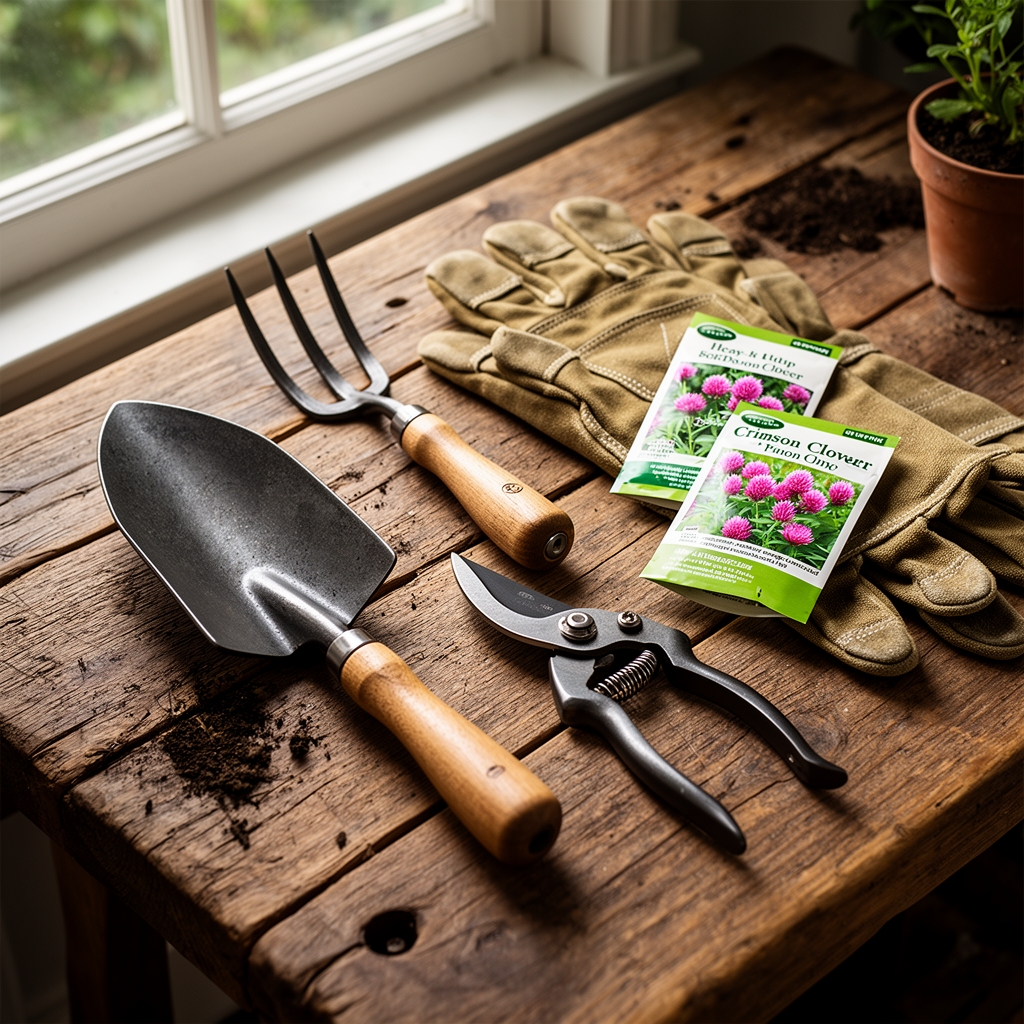
Successful establishment requires soil pH between 6.0 and 7.0. Test kits measuring cation exchange capacity reveal whether amendments are necessary. For acidic sites below pH 5.5, apply dolomitic limestone at 50 pounds per 1,000 square feet six weeks before seeding.
Seeds arrive in two forms: raw or inoculated. Purchase inoculated seed pre-coated with Rhizobium trifolii bacteria, or mix 1 ounce of powdered inoculant per pound of raw seed. Store inoculant below 40 degrees Fahrenheit to preserve bacterial viability.
Nutrient requirements remain modest. Crimson clover thrives without nitrogen fertilizer because of biological fixation. Apply a starter blend rated 0-20-20 at 10 pounds per 1,000 square feet if soil tests reveal phosphorus below 25 ppm or potassium below 150 ppm. Avoid high-nitrogen formulas like 10-10-10; excess nitrogen inhibits nodule formation and reduces fixation efficiency by 40 percent.
Equipment includes a broadcast spreader for areas larger than 500 square feet, a garden rake for seedbed preparation, and a roller or cultipacker weighing at least 200 pounds. The roller ensures seed-to-soil contact essential for germination in 7 to 10 days.
Timing
Plant crimson clover 6 to 8 weeks before the first hard frost in your hardiness zone. In Zone 7, sow between August 15 and September 15. Zone 6 gardeners should complete planting by August 31. Warmer Zone 8 and 9 regions allow seeding through October 15.
Spring planting works in Zones 3 through 5 where fall establishment fails. Sow as soon as soil temperatures reach 50 degrees Fahrenheit, typically mid-March to early April. Spring-planted crimson clover blooms by late June but produces 30 percent less biomass than fall-seeded stands because shorter vegetative growth periods limit root and shoot development.
Frost tolerance defines crimson clover's northern range. Seedlings survive temperatures to 10 degrees Fahrenheit once they develop three true leaves. Younger seedlings with only cotyledons suffer winter kill below 20 degrees. Mature plants tolerate brief dips to 0 degrees but lose foliage and delay spring regrowth.
Phases

Sowing
Clear the planting area of debris and existing vegetation. Mow weeds to ground level, then rake to expose bare soil. Crimson clover seed measures 1/8 inch in diameter and requires shallow placement at 1/4 to 1/2 inch depth. Broadcast 20 to 25 pounds per acre (roughly 1/2 pound per 1,000 square feet) for dense cover. Increase seeding rates by 20 percent if sowing into untilled soil or heavy residue.
Rake lightly after broadcasting to incorporate seed, then roll or tamp the surface. Firm contact between seed coat and soil particles accelerates imbibition, the water absorption phase initiating germination.
Pro-Tip: Mix seed with mycorrhizal fungi inoculant containing Glomus intraradices. These arbuscular fungi colonize root hairs within 14 days, extending nutrient uptake reach by 100-fold and increasing phosphorus availability in low-fertility soils.
Transplanting
Crimson clover rarely requires transplanting. Direct seeding remains the standard method. In experimental settings where transplants are used, start seeds in 72-cell trays filled with soilless mix 3 to 4 weeks before outdoor planting. Transplant when seedlings reach 2 inches tall with two sets of true leaves. Space transplants 6 inches apart in rows 12 inches apart. Transplant shock delays maturity by 10 to 14 days compared to direct-seeded plants.
Establishing
Germination occurs within 7 days given adequate moisture and soil temperatures between 50 and 85 degrees Fahrenheit. Seedlings emerge with two oval cotyledons, followed by the first trifoliate leaf at day 12. Full canopy closure happens 40 to 50 days after emergence in fall plantings.
Fall-planted crimson clover enters semi-dormancy when day length drops below 10 hours. Growth resumes in February or March as auxin distribution shifts toward apical meristems. Flower buds form when day length exceeds 12 hours and temperatures average 60 degrees for seven consecutive days.
Pro-Tip: Scout for nodulation 25 days after emergence. Dig a plant and examine roots for pink or red nodules indicating active nitrogen fixation. Absence of nodules signals inoculant failure; side-dress 10 pounds of ammonium sulfate per 1,000 square feet to prevent nitrogen deficiency.
Troubleshooting
Symptom: Yellowing lower leaves and stunted growth in seedlings.
Solution: Low soil pH inhibits nutrient uptake. Retest soil and apply lime if pH falls below 5.8. Apply foliar kelp extract at 1 tablespoon per gallon weekly until green color returns.
Symptom: Circular brown lesions with concentric rings on leaves.
Solution: Southern blight (Sclerotium rolfsii) thrives in warm, humid conditions. Improve air circulation by thinning plants to 4-inch spacing. Remove infected plants immediately. Avoid overhead irrigation.
Symptom: Sparse germination below 50 percent.
Solution: Seed planted too deep or soil crusting prevents emergence. Crimson clover seed contains limited energy reserves. Rake crusted soil lightly to break surface tension. Reseed at 1/4 inch depth.
Symptom: Plants lodge (fall over) before flowering.
Solution: Excess nitrogen or dense seeding creates weak, elongated stems. Reduce seeding rate to 15 pounds per acre in fertile soils. Avoid nitrogen application.
Symptom: White cottony growth on stems near soil line.
Solution: White mold (Sclerotinia trifoliorum) develops in cool, wet springs. Increase row spacing to 18 inches. Apply Bacillus subtilis biocontrol at first symptom appearance.
Maintenance
Provide 1 inch of water weekly if rainfall totals less than this amount during the first 30 days. Established crimson clover tolerates moderate drought but biomass production drops 25 percent when soil moisture falls below 50 percent field capacity.
Mow spring stands when 10 percent of flowers open, typically mid-May in Zone 7. Cutting at early bloom maximizes nitrogen content at 3.5 percent dry weight. Delayed mowing reduces nitrogen to 2.8 percent as carbohydrates translocate to seed production.
Incorporate crimson clover residue 2 to 3 weeks after mowing. Biomass decomposes within 20 days given soil temperatures above 60 degrees and adequate moisture. The carbon-to-nitrogen ratio of 15:1 ensures rapid mineralization without nitrogen tie-up.
No supplemental fertilization is necessary during the growing season. Crimson clover accumulates phosphorus and potassium from subsoil layers, recycling these nutrients to the surface upon decomposition.
FAQ
How much nitrogen does crimson clover add to soil?
Mature stands fix 80 to 130 pounds of nitrogen per acre. Actual amounts depend on nodulation success, growing season length, and final biomass. Spring soil tests following incorporation show available nitrogen increases of 60 to 90 pounds per acre.
Can crimson clover reseed itself?
Yes, but reseeding success varies. Allow 30 percent of plants to mature seed in late May. Seeds shatter naturally and germinate the following fall. Volunteer stands typically achieve 40 to 60 percent of original density.
Does crimson clover attract beneficial insects?
Flowering crimson clover supports over 50 native bee species, including bumblebees and mason bees. Syrphid flies and parasitic wasps feed on nectar while larvae consume aphids and caterpillar pests in adjacent crops.
When should I terminate crimson clover before planting vegetables?
Mow or till 3 weeks before transplanting warm-season crops like tomatoes or peppers. This interval allows initial decomposition and prevents allelopathic interference. Cool-season crops like lettuce tolerate shorter 10-day intervals.
Will crimson clover survive in shade?
Partial shade reduces growth by 50 percent. Crimson clover requires minimum 6 hours of direct sun daily for adequate photosynthesis and biomass production. In full shade, plants become leggy and fail to flower.